
- General Info
- About Us
- Articles/Blog
- Distributors
- Contact
How to Select Your Cushion

Want to feel the pressure quality range for yourself before ordering? Order a SAMPLE PACK for only $5.00. Shipping is free.
Support Selection
SunMate cushions are available in 10 degrees of support: XX-Soft, Extra-Soft, Soft, Medium-Soft, Medium, Medium-Firm, Firm, Extra-Firm, XX-Firm and Hard (T50E). This provides a wide support range for any weight or weight-distribution need.
Choose Soft for Comfort Layers or Supporting Lighter Weights:
|
Choose Medium for Support for a Wide Range of Weights:
|
|
Choose Firm for Hot Climates, Impact Absorption or Supporting Heavier Weights:
SunMate has a thermoplastic quality, which means it will soften slightly when it's hot, and firm slightly when it's cold.
|
Energy Absorption
SunMate is designed to absorb tremendous amounts of impact shock and vibration energy. That is why SunMate is used for many engineering applications.
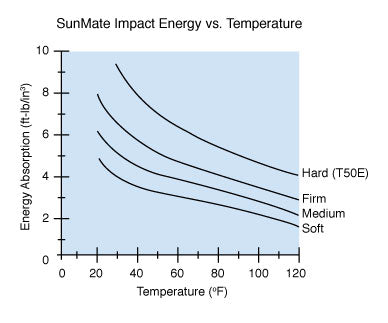
Firmer SunMate cushions are more energy-absorbent. Energy absorption is temperature-dependent:
Normal use temperature range: 0-120°F
Functional temperature range: -20-150°F
Slow degradation starts: 300°F
Density: 5 lb/ft3
"Which Cushion Is Best for Me?"
This is the most commonly asked question by our customers. The answer depends on many individual factors such as body weight, level of support required, and application.
The information on this page will help you select the appropriate cushion pressure quality and thickness for your application. If you need further assistance, our customer service reps are happy to help.
Calculating Support Pressure
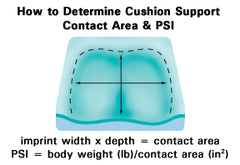 Except for lower leg weight, which is supported by a foot rest or the floor, a seated person is supported by the body contact area of the seat cushion.
This is where the unique properties of SunMate come into play. SunMate cushions are formulated in a wide range to comfortably and uniformly support any weight. The proper cushion allows the body to sink to a sufficient depth to maximize the contact area and reduce seating pressure without bottoming-out.
A support pressure measurement (in PSI) correlates to the softness of a SunMate cushion. The SunMate Applications Chart shows which cushion PSI is typically used for a given application. Certain support pressures perform best for certain functions.
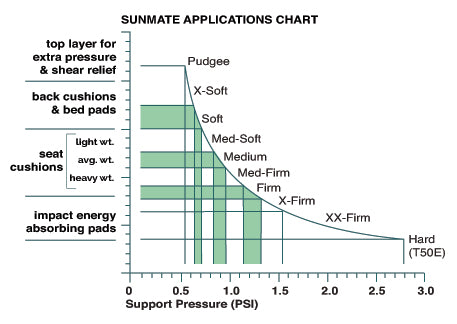
The average support pressure is found by dividing the weight of the person by the area of the seating imprint in square inches. A support pressure in the range of 0.8 to 1.0 PSI is typical for an average-weight person.
Choosing the Correct Cushion
The Body Weight & Cushion Thickness Chart can be used as a general aid in the selection of SunMate cushions. For example, a person weighing 200 lb is represented on the following charts by a horizontal dotted line. A vertical dotted line is extended up from the desired cushion thickness, 2.5". The point at which the lines intersect indicates the recommended pressure quality or density of SunMate needed to provide adequate support. You may elect to choose a grade softer or firmer based on personal preference, environment in which the cushion will be used, or application requirements. Layering with different pressure qualities and thicknesses is another way to accomplish just the right feel. Order a Sample Pack shipped free.
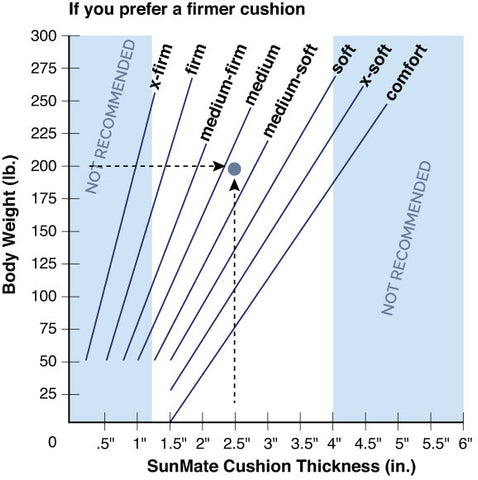
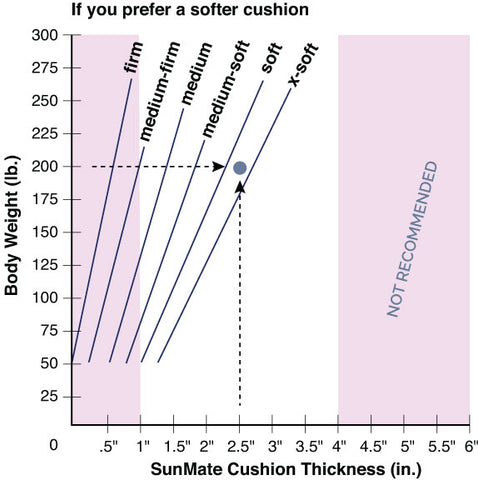
The blue and pink shaded areas of the chart represent cushion specifications that are usually not required. Cushions less than 1" thick generally do not provide maximum support, and are only recommended when used in conjunction with another cushion. Cushions more than 4" thick are usually in excess of body support requirements.
- All Rights Reserved. SunMate®, Pudgee®, and Liquid SunMate® are registered trademarks of Dynamic Systems, Inc.
TOLL FREE: 855-SUNMATE, TEL: 828-683-3523 -


